Wednesday, 13 August 2014

Hemp Fibres 'Better Than Graphene'


The waste fibres from hemp crops can be transformed into high-performance energy storage devices, scientists say.

They "cooked" cannabis bark into carbon nanosheets and built supercapacitors "on a par with or better than graphene" - the industry gold standard.
Graphene is the name given to a novel substance composed of a single layer of carbon atoms, extracted from graphite, with astonishing properties: the stuff is stronger than diamond, more conductive than copper and more flexible than rubber.

Tuesday, 12 August 2014

Google Backs US$300 Million Cable Project To Lay 5,000 Miles Of Superfast Broadband Across The Pacific Ocean

Called Faster, the project will connect Japan to the west coast of the US. The cable will stretch 5,000 miles (8,000 km) under the ocean, at depths of around 7,000 miles (11,300 km), and will then link up with local cable systems already in place. Faster is expected to be complete by Spring 2016

Google is investing further in the underground cable network by backing a project that will span the Pacific Ocean.
Called Faster, the $300 million (£178 million) scheme will connect Japan to the west coast of the US.
The cable will stretch 5,000 miles (8,000km) under the ocean, and will then link up with local cable systems already in place.
Faster is expected to be completed by Spring 2016.
On the Japan side, the cable will land at Chikura and Shima and is designed to improve the network further into Asia.
While on the US side, the cable will connect networks in Los Angeles, San Francisco, Portland, and Seattle.
‘At Google we want our products to be fast and reliable, and that requires a great network infrastructure, whether it's for the more than a billion Android users or developers building products on Google Cloud Platform,’ said Urs Hölze, senior vice president of technical infrastructure at Google.
‘And sometimes the fastest path requires going through an ocean.
'That’s why we’re investing in Faster, a new undersea cable that will connect major West Coast cities in the US to two coastal locations in Japan with a design capacity of 60 terabits per second.’
That’s ten million times faster than a household cable modem.
Google has previously invested in other cable projects, including Unity in 2008, which also joined Japan to the US, and the South-East Asia Japan Cable (SJC) in 2011.
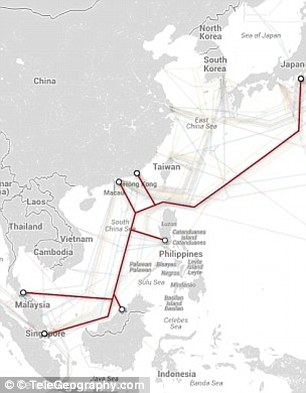
South-East Asia Japan Cable (SJC) in 2011

The SJC links eight points in Asia including Chikura in Japan, Shantou in China, Chung Hom Kok, Hong Kong, Nasugbu, the Philippines, Telisai, Brunei, Songkhla, Thailand, and Tuas, Singapore.
In addition to Google, the Faster project has been backed by China Mobile International, China Telecom Global, Global Transit, KDDI, and SingTel.
Mr. Woohyong Choi, the chairman of the Faster executive committee, said: 'Faster is one of a few hundred submarine telecommunications cables connecting various parts of the world.
'These cables collectively form an important infrastructure that helps run global Internet and communications.
‘The Faster cable system has the largest design capacity ever built on the Trans-Pacific route, which is one of the longest routes in the world.
‘The agreement announced today will benefit all users of the global Internet.'
Almost 95 per cent of the internet used everyday is carried between countries through two-inch (50mm) thick lines.
In 2006, submarine cables carried just one per cent of traffic - an increase of 94 per cent in just eight years, according to official figures from the International Cable Protection Committee.
Since 2012, the number of submarine cables have almost doubled from 150 to 285. 

Culled from Daily Mail

Wednesday, 6 August 2014

Europe's Rosetta Probe Goes Into Orbit Around Comet 67P

Rosetta has caught up with 67P/Churyumov-Gerasimenko

Europe's Rosetta probe has arrived at a comet after a 10-year chase. 
In a first for space history, the spacecraft was manoeuvred alongside a speeding body to begin mapping its surface in detail.
The spacecraft fired its thrusters for six and a half minutes to finally catch up with comet 67P/Churyumov-Gerasimenko.
"We're at the comet!" said Sylvain Lodiot of the European Space Agency (ESA) operations centre in Germany.
"After 10 years, five months and four days travelling towards our destination, looping around the Sun five times and clocking up 6.4 billion km, we are delighted to announce finally 'we are here'," said Jean-Jacques Dordain, director general of Esa. 

Deep slumber
Launched on board an Ariane rocket in March 2004, Rosetta has taken a long route around our Solar System to catch up with comet 67P.
In a series of fly-pasts, the probe used the gravity of the Earth and Mars to increase its speed during the 6 billion km chase.
To save energy, controllers at ESA's centre in Darmstadt, Germany, put Rosetta into hibernation for 31 months.
In January they successfully woke the craft from its slumber as it began the final leg of the daring encounter.
For the past two months, Rosetta has been carrying out a series of manoeuvres to slow the probe down.
The comet is travelling at 55,000km per hour (34,175 mph). The spacecraft's speed has been adjusted so that in relative terms it will be flying beside the comet at a slow walking pace of 1m/sec (2.2mph, 3.6kph).
At a distance of 550 million km from the Earth, messages are taking over 22 minutes to get to Rosetta.
The distances involved are so great that the complex final command sequence for Wednesday's crucial thruster burn had to be issued on Monday night. 
"This arrival phase in fact is the most complex and exotic trajectory that we have ever seen," said Jean-Yves Le Gall, president of the French Space Agency CNES.


Rosetta will have to continue to fire its thrusters every few days to maintain a hyberbolic orbit at 100km above the rotating rock.
The craft will then travel alongside the comet for the next 15 months, studying it with a range of instruments.

Rosetta has been taking increasingly detailed photographs of 67P as it gets closer.

The mysterious comet has been dubbed the "rubber duck", as some images seem to show the familiar shape as it twirls in space. 
Project scientist, Dr Matt Taylor, said: "For me this is the sexiest, most fantastic mission there's ever been. It's ticking a number of boxes in terms of fascination, exploration, technology and science - predominantly science." 

Harpooning a comet 
As it moves towards the Sun, 67P will warm up and its trailing halo of gas and dust - known as the coma - will increase, offering the orbiter the chance to do some detailed scientific work.
"We've seen evidence of the out-gassing of the coma, the outer atmosphere of the comet, this is made of dust and gas," said Dr Taylor.
"We have instruments on board that will start sniffing for this gas and taste it, we will also be collecting some of this dust and touching the coma itself. Hopefully that will occur sometime this week."
The mission gets even more ambitious in November when, after moving Rosetta closer to 67P, mission controllers will attempt to put the Philae lander on the surface.
The lander will use harpoons to anchor itself and will carry out a series of experiments, including drilling into the material that makes up the comet. 
The mission aims to add to knowledge of comets and their role in ferrying the building blocks of life around the early Solar System.

Originally appeared in BBC